Why Manufacturing Still Matters
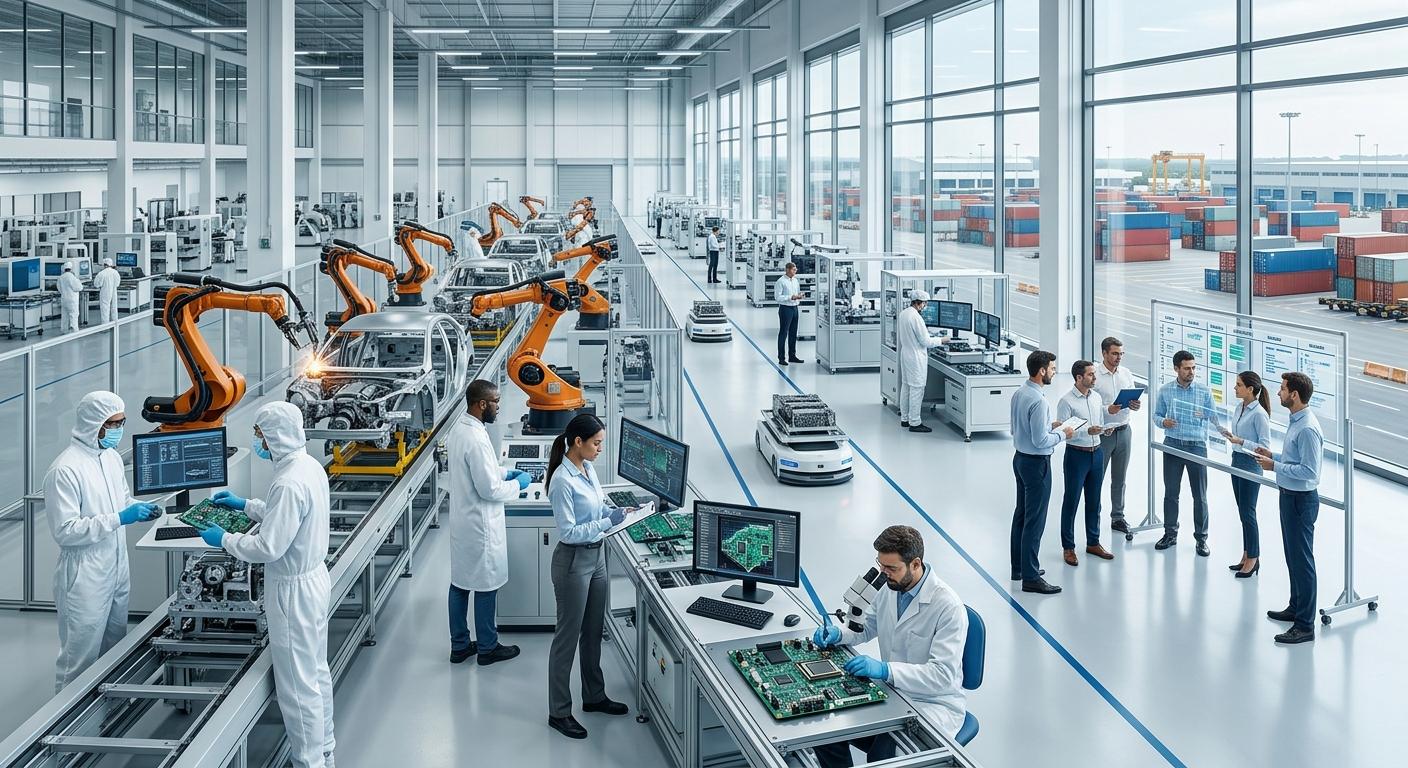
Why Manufacturing Still Matters
In the late eighteenth and early nineteenth centuries, the world witnessed a transformation that would reshape it forever. Great Britain, already the foremost power of its age, became the world's first industrial nation, shifting from human and animal labour to steam power and water mills. Breakthroughs in steel and electricity production followed, and when Henry Ford introduced the moving assembly line in 1913, mass production ushered in a new economic era.¹
Manufacturing has been an engine of wealth creation for many of the world's fastest-growing emerging economies. It is widely credited with driving a significant share of global growth over the past half-century while generating substantial employment. Research on local economies in the United States, for example, has found that each additional manufacturing job can generate additional employment in local non-tradable sectors.² That multiplier effect is one reason many countries have used manufacturing to raise living standards within a relatively short period.
Germany and Japan are among the clearest early examples. Their economies were devastated and their infrastructure heavily damaged by the Second World War, yet both rebuilt themselves with manufacturing playing a central role in their post-war recoveries. Industrial capabilities that had once supported wartime production were reoriented towards cars, electronics, steel and other civilian goods, helping both countries become global manufacturing powerhouses within a generation.
South Korea's transformation is just as striking. Its GDP per capita was below $200 in the early 1960s in current US-dollar terms; today it is well above $30,000.³ Samsung and Hyundai are only the most visible symbols of a much broader industrial success story.
But no country illustrates manufacturing's transformative power better than China. Emerging from the upheaval of the Cultural Revolution and the rigidities of central planning, China changed course in the late 1970s. Market reforms, foreign investment and rapid industrialisation helped trigger an economic transformation with few historical parallels. Nearly 800 million people were lifted out of extreme poverty over the subsequent four decades,? while GDP per capita rose from around $1,000 in 2000 to more than $13,000 in 2024, in current US-dollar terms.?
China's industrial expansion has also transformed its role in the global economy. Manufacturing accounted for about 25 percent of GDP in 2024, according to World Bank data,? while the country's merchandise exports reached approximately $3.58 trillion that year, making China the world's largest exporter.? Its manufacturing sector has evolved substantially over the decades. China initially attracted foreign investment and built its export base through low-cost, labour-intensive production before gradually moving into higher-value industries and more technologically sophisticated manufacturing.
Pakistan tells a very different story. A country of more than 240 million people, it had a strong start in the 1960s and early 1970s, when it was regarded as something of a role model in Asia and was, in several respects, ahead of its regional peers. It has since struggled to keep pace with the changing demands of modern manufacturing. Manufacturing accounted for about 13 percent of Pakistan's GDP in 2024, compared with 22 percent in Bangladesh, 24 percent in Vietnam and 25 percent in China.?
More recently, Pakistan has shown signs of deindustrialisation. High energy costs, security concerns, a shortage of skilled labour, including the loss of skilled workers through emigration, and limited private-sector innovation have left the country trailing several regional peers. Bangladesh and Vietnam, by contrast, have built powerful export-oriented manufacturing sectors, particularly in textiles, garments and electronics. Both have positioned themselves as important links in global supply chains and have benefited from multinational companies seeking to diversify their production bases.
Many now argue that services, technology and artificial intelligence represent the next major leap for emerging economies — one that could allow them to bypass manufacturing altogether. The importance of the technology boom to the future of the global economy is not in dispute. But some caution is warranted.
For many successful emerging economies, the transition from agriculture to advanced services and high technology was preceded by the development of substantial productive and industrial capabilities. Countries such as South Korea and China demonstrate how manufacturing can help build the infrastructure, logistics, quality-control systems, technical skills and capacity to adopt new technologies that are essential to broader economic transformation.
Manufacturing also creates a large base of productive employment, generates export earnings and expands the tax and investment capacity needed for infrastructure, education and skills development. As economies become more productive, services can expand around them, while technological capabilities developed in industry can spill over into other parts of the economy.
Manufacturing, in short, remains an important bridge between a low-productivity economy and a more diversified, technology-intensive one. Pakistan cannot afford to assume that services, technology or artificial intelligence will automatically substitute for the productive capabilities it has yet to build.
Pakistan is still far from that bridge — but the journey has to start somewhere. Right now, it is going nowhere.
The writer, Ibrahim Aftab, is a student of economics at the Institute of Management Sciences, Peshawar.
References
History.com Editors, “Ford's Assembly Line Starts Rolling,” History.com.
History.com reference
Enrico Moretti, “Local Multipliers,” American Economic Review, Vol. 100, No. 2, 2010, pp. 373–377.
American Economic Association reference
World Bank, World Development Indicators, GDP per capita — Korea, Rep.
World Bank data
World Bank, “Lifting 800 Million People Out of Poverty – New Report Looks at Lessons from China's Experience,” April 1, 2022. The World Bank reports that close to 800 million people were lifted out of extreme poverty in China over four decades. W

World Bank
World Bank reference
World Bank, World Development Indicators, GDP per capita — China.
World Bank China data
World Bank, World Development Indicators, “Manufacturing, value added (% of GDP).” The 2024 figures are approximately 13 percent for Pakistan, 22 percent for Bangladesh, 24 percent for Vietnam and 25 percent for China. W

World Bank Open Data+1
World Bank manufacturing data
World Trade Organization, China Member Profile. China's merchandise exports totalled approximately $3.58 trillion in 2024. W

WTO Tariff and Trade Data+1
WTO China trade data
World Bank, World Development Indicators, “Manufacturing, value added (% of GDP).” W
World Bank Open Data+1
World Bank manufacturing indicator


Related News
-
 NAB KP Holds Briefing on Legal Framework for Government Land Leasing
 -
 Anti-Corruption Team Arrests Nowshera Patwari Red-Handed in Bribe Trap
 -
 Mashokhel Residents Demand Action Over Poor and Unreliable Internet Service
 -
Any Foreign Military Presence in Strait of Hormuz Will Be Considered Aggression: Iran
-
RIC Nurses Protest After Nurse Allegedly Assaulted by Patient’s Relatives