NAB KP Holds Briefing on Legal Framework for Government Land Leasing
NAB KP Holds Briefing on Legal Framework for Government Land Leasing
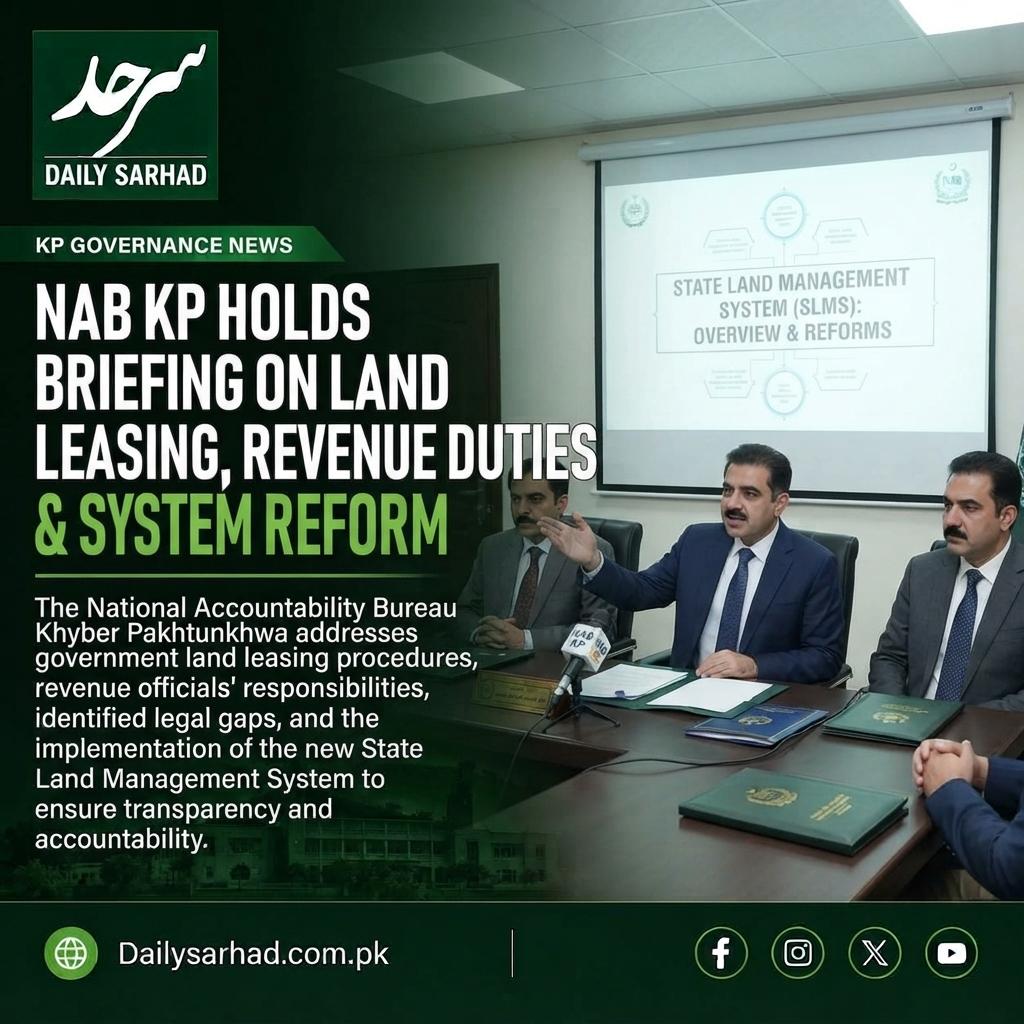
PESHAWAR: The National Accountability Bureau (NAB) Khyber Pakhtunkhwa organized a comprehensive briefing session on land and revenue matters, the responsibilities of revenue authorities, and the legal and administrative framework governing the leasing of government land in the province.
NAB Chairman Lieutenant General (Retired) Nazir Ahmed participated in the session via Zoom. Prosecutor General Accountability Syed Ehtesham Qadir Shah and Chief Secretary Khyber Pakhtunkhwa Shahab Ali Shah also attended, along with advisers to the NAB chairman, directors general, provincial secretaries, heads of various departments, and officers representing NAB and the provincial administration.
The session began with the recitation of the Holy Quran, followed by opening remarks from NAB Khyber Pakhtunkhwa Director General Naveed Haider Zaidi. He said NAB was working under a three-pronged strategy of Awareness, Prevention and Enforcement.
Under this vision, the NAB chairman established a Land Directorate in 2025 to help prevent encroachment on government assets, illegal allotments, and fraudulent or unlawful transfers of public property. According to the briefing, 2.98 million acres of land valued at Rs5.976 trillion were recovered across the country during 2025, while the recovery of hundreds of thousands of acres of government land is continuing in 2026.
In Khyber Pakhtunkhwa, a review of government land records also identified several significant irregularities. Officials noted gaps and discrepancies between the records maintained by deputy commissioners and those held by relevant departments due to the absence of a centralized record of government land. Questions also remained regarding departments’ actual rights of use, while cases involving unauthorized leasing, mortgaging and occupation without approval from the Board of Revenue were highlighted.
To address these issues and data gaps, NAB Khyber Pakhtunkhwa has developed the State Land Management System (SLMS), a software system designed to consolidate records of all government land in the province into a single searchable database accessible through a centralized platform.
A detailed presentation titled “Legal Framework of Land Revenue Matters in Khyber Pakhtunkhwa: Responsibilities and Duties of Revenue and Relevant Departments” was delivered by NAB Chairman’s Adviser on Land Affairs Ahmed Ali Zafar.
He reviewed the historical background of land and revenue administration in the province and explained the existing legal framework. The session covered the appointment and duties of revenue officers, the jurisdiction of civil courts in revenue matters, and ambiguities surrounding the discretionary powers exercised by provincial and local governments in matters concerning government land.
NAB Director General Operations Amjad Majeed Aulakh presented the findings of NAB’s study on the leasing of government land in Khyber Pakhtunkhwa. He highlighted key issues identified in the existing system and put forward recommendations aimed at improving transparency, institutional oversight and the effective management of government land.
Another session, titled “Judgments of Higher Courts Regarding the Responsibilities of Land Revenue Authorities in Relation to Government Land,” was presented by NAB Prosecutor General Syed Ehtesham Qadir Shah.
He emphasized that government land is a public trust and that strict compliance with legal and judicial requirements is essential for its protection. Referring to relevant judgments of the Supreme Court and Sindh High Court, he explained that such decisions not only help resolve disputed matters but also provide important guidance to revenue authorities regarding the lawful management, use and disposal of public land, particularly through transparent and fair market mechanisms.
The presentations were followed by an extensive question-and-answer and interactive discussion session. Participants discussed various legal, administrative and practical issues related to land revenue administration, the management and protection of government land, and its leasing.
Addressing the participants, Chief Secretary Khyber Pakhtunkhwa Shahab Ali Shah appreciated the initiative and said that such collaborative sessions could contribute to improving mechanisms for the recovery and protection of government land.
He said the lessons learned from the workshop and the recommendations emerging from it could also assist in reviewing and developing appropriate legislation to address existing legal and administrative gaps.
In his concluding remarks, NAB Chairman Lieutenant General (Retired) Nazir Ahmed expressed satisfaction over cooperation between NAB and the civil administration of Khyber Pakhtunkhwa.
He said coordinated and joint institutional efforts could help unlock the economic and public benefits of government land. He observed that the province possessed a large area of government land that required effective measures for its identification, protection and recovery.
The NAB chairman stressed that, in cooperation with the Khyber Pakhtunkhwa administration, NAB could contribute to strengthening institutional systems and addressing administrative and governance gaps that hinder the effective and lawful management of public resources.
He further emphasized that government officials must exercise their powers within the limits of the law and ensure effective compliance with all relevant legal and constitutional requirements.
He added that if shortcomings had occurred in the past, the focus should remain on corrective measures, institutional improvement and adherence to the law. He directed that a comprehensive roadmap and effective mechanism be developed to address the issues identified during the workshop and translate the recommendations into practical measures.
The workshop concluded with a shared understanding that good governance and anti-corruption efforts are complementary pillars of effective state administration, while stronger institutional cooperation between NAB and provincial authorities could help mobilize additional public resources for provincial development and the broader public interest.


Related News
-
 Anti-Corruption Team Arrests Nowshera Patwari Red-Handed in Bribe Trap
 -
 Why Manufacturing Still Matters
 -
 Mashokhel Residents Demand Action Over Poor and Unreliable Internet Service
 -
Any Foreign Military Presence in Strait of Hormuz Will Be Considered Aggression: Iran
-
RIC Nurses Protest After Nurse Allegedly Assaulted by Patient’s Relatives